
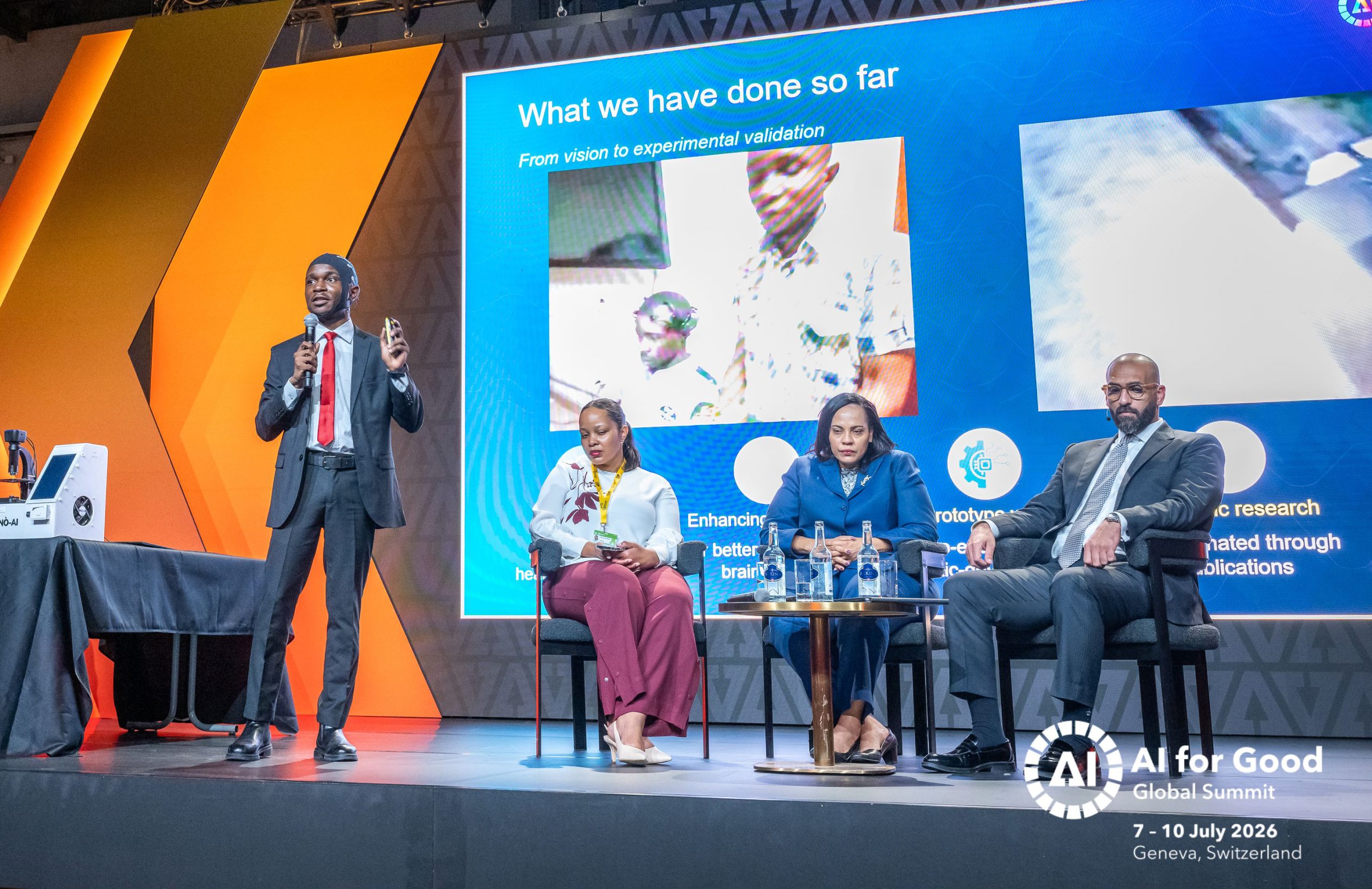

Tosali Technologies was represented at the 2026 AI for Good Global Summit in Geneva, where Pierre Sedi presented Cerebro, an affordable brain-computer interface designed to support people living with severe motor impairment.
Pierre Sedi was invited to speak at the 2026 AI for Good Global Summit, the leading annual United Nations event dedicated to artificial intelligence, organised by the International Telecommunication Union (ITU) in collaboration with more than 50 United Nations partners.
He took part in the Frontier Stage session entitled “How Africa’s young innovators are solving real-world challenges with AI,” which highlighted emerging African innovators using artificial intelligence to address pressing social and developmental challenges. During the session, Pierre presented Cerebro, an affordable brain-computer interface project aimed at enabling people with severe motor impairment to control robotic assistive devices using only the power of thought.
Addressing an urgent healthcare and inclusion challenge
The presentation highlighted the scale of disability and the shortage of specialised healthcare professionals around the world, particularly in Africa. Approximately 1.3 billion people worldwide live with significant disability, while more than 80 million people in Africa live with some form of disability. However, the number of people living with severe disabilities on the continent remains largely unknown. Complete loss of motor ability in the arms and legs is estimated to affect between 40 and 80 people per million inhabitants.
The presentation also drew attention to the severe shortage of neurosurgeons. The recommended threshold is one neurosurgeon per 100,000 inhabitants, yet 161 countries out of 193, representing approximately 83%, do not meet this criterion. In the Democratic Republic of Congo, there are only around 10 neurosurgeons for a population exceeding 100 million people. This means that the country would require approximately 100 times more neurosurgeons to meet the recommended threshold. These figures demonstrate the urgent need for affordable, scalable and locally adaptable healthcare technologies.
An affordable brain-computer interface for underserved communities
Cerebro is being developed as a low-cost, scalable and context-adapted neurotechnology solution for Africa and other least developed countries. The system combines:
- non-invasive EEG brain-signal acquisition;
- artificial intelligence for decoding motor intention;
- robotic assistive-device control; and
- a future clinical pathway towards hospital-based rehabilitation.
By interpreting imagined movements, Cerebro seeks to transform a person’s intention into commands that can be used to control assistive robotic devices. The long-term ambition is to help restore greater autonomy, dignity and interaction for individuals who may be conscious and mentally alert but unable to move their arms or legs.
From experimental research to clinical impact
Cerebro is currently progressing through experimental validation, including brain-computer interface studies involving research participants and the continued development of AI models for EEG decoding. The project’s next milestone is to move towards clinical impact by supporting bedridden patients with severe motor impairment through brain-controlled robotic beds.
These systems are intended to help reduce complications associated with prolonged bed rest, support patient repositioning and rehabilitation, and potentially accelerate recovery. The planned clinical pathway will also allow the team to collect essential medical and technical data, assess usability in real hospital environments and continuously improve the reliability of the brain-computer interface.
African innovation on a global stage
Pierre Sedi’s participation in the AI for Good Global Summit provided an opportunity to demonstrate that African researchers and innovators are not only addressing local challenges but are also contributing to the future of global artificial intelligence, healthcare and assistive technology.
Cerebro contributes to several United Nations Sustainable Development Goals (SDGs), particularly:
- SDG 3 — Good Health and Well-being
- SDG 9 — Industry, Innovation and Infrastructure
- SDG 10 — Reduced Inequalities
- SDG 17 — Partnerships for the Goals
Tosali Technologies and the Cerebro team remain committed to building partnerships with hospitals, researchers, engineers, healthcare professionals, development organisations and investors to advance the project from research to responsible clinical implementation.
